

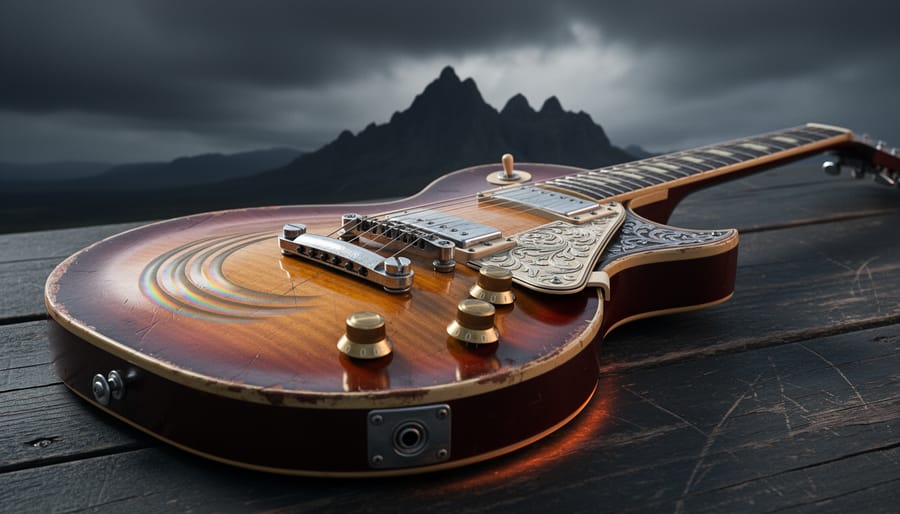
“Man on the Silver Mountain” is the thunderous opening statement that launched Ritchie Blackmore’s Rainbow into rock history, a three-minute masterclass in how to blend medieval mysticism with pure guitar-driven power. Released in 1975 as the lead single from the Rainbow debut vinyl this track proved Blackmore could step out from Deep Purple’s shadow and create something equally vital but distinctly his own.
The song’s genius lies in its deceptive simplicity. That iconic riff, all four notes of it, cuts through five decades of rock radio with the same edge it had when Ronnie James Dio first belted those cryptic lyrics about mystical mountain dwellers. Recorded in just a few takes at Musicland Studios in Munich, the track captures lightning in a bottle: Blackmore’s neoclassical guitar wizardry meeting Dio’s soaring vocals for the first time, backed by a rhythm section that knew exactly when to get out of the way.
For BC’s classic rock fans, this is the song that still kicks off road trips and backyard gatherings, the one that reminds us why guitar heroes mattered then and still matter now. Whether you discovered it through your dad’s vinyl collection or Spotify’s algorithm, “Man on the Silver Mountain” remains a gateway to understanding what made 70s hard rock so electrifying.
The Birth of Rainbow and a Game-Changing Track
Ritchie Blackmore didn’t leave Deep Purple on a whim. By 1975, creative tensions and exhaustion from relentless touring pushed him to break away from one of rock’s biggest acts and pursue something entirely his own. He wanted freedom to explore the medieval and classical influences that fascinated him, blending them with hard rock in ways Deep Purple’s direction wouldn’t allow. The result was Rainbow, a project that let Blackmore craft a darker, more mystical sound without compromise.
The centerpiece of this vision was “Man on the Silver Mountain,” the opening salvo on the 1975 debut release. Recorded at Musicland in Munich the album came together quickly, but the chemistry was immediate. Blackmore assembled a lineup that included bassist Craig Gruber, drummer Gary Driscoll, and keyboardist Micky Lee Soule, but the real game-changer was his choice of vocalist. Ronnie James Dio was included after impressing Blackmore during his time fronting Elf, and his operatic power and gift for fantasy storytelling proved the perfect match for the guitarist’s ambitious new direction.
“Man on the Silver Mountain” captured everything Blackmore wanted to achieve. The track’s driving riff was leaner and meaner than Deep Purple’s sprawling jams, while Dio’s vocals soared over lyrics steeped in mythology and magic. It wasn’t just a departure from his past, it was a declaration. This was Blackmore unfiltered, chasing a sound that would define not just Rainbow’s identity but influence an entire generation of metal and power metal bands to come.
What Makes ‘Man on the Silver Mountain’ So Iconic
That Unforgettable Riff
Blackmore’s opening riff for ‘Man on the Silver Mountain’ is deceptively simple, a descending four-note phrase built on power chords that immediately grabs your attention. What makes it brilliant isn’t complexity; it’s the confidence and swagger in its delivery. He plays it clean and direct, letting each note ring out with clarity before the full band crashes in.
The riff sits in a comfortable mid-range that gives it weight without muddying the mix. Blackmore understood that a great rock riff doesn’t need to be flashy. This one proves you can create something memorable with just a handful of notes arranged in the right order. The slight bluesy bend he adds gives it character, a small touch that shows his classical training meeting raw rock instinct.
Listen closely and you’ll hear how he uses palm muting to control the dynamics, creating tension before releasing it. That restraint is what separates good guitar players from legends. The riff repeats throughout the song, but it never gets old, it’s the anchor that everything else builds around.
Dio’s Vocal Majesty
Ronnie James Dio didn’t just sing “Man on the Silver Mountain”, he transformed it into something mythic. His voice soared with an operatic power that hard rock had rarely heard before, carrying those fantasy-themed lyrics with absolute conviction. Where other vocalists might have sounded silly singing about silver mountains and rainbows in the dark, Dio made you believe every word. His range, control, and dramatic delivery on this track announced a new standard for rock singers, proving that technical prowess and raw emotion could coexist. The frontman impact was immediate, Dio became the voice that defined Rainbow’s sound and set the template for countless power metal and heavy rock vocalists who followed.
Mystical Lyrics and Fantasy Themes
Ronnie James Dio’s lyrics for “Man on the Silver Mountain” pulled hard rock into uncharted territory, trading typical themes of love and rebellion for something far more enigmatic. The silver mountain itself remains deliberately ambiguous, part mystical quest destination, part metaphor for unreachable ideals. Lines like “I’m a wheel, I’m a wheel, I can roll, I can feel” suggest transformation and spiritual journey rather than straightforward storytelling.
This fantasy-driven approach wasn’t just window dressing. While bands like Led Zeppelin occasionally dabbled in mythology, Rainbow made it their identity from track one. Dio’s fascination with medieval imagery and symbolic landscapes gave the song a timeless, almost cinematic quality that separated it from the blues-based hard rock dominating 1975. The vagueness worked in its favor, listeners could project their own interpretations onto the mysterious mountain, whether they heard it as enlightenment, artistic ambition, or pure escapist adventure.

The Song’s Impact and Legacy
When “Man on the Silver Mountain” hit airwaves in 1975, it didn’t just announce a new band, it helped forge a template for an entire subgenre. The track’s marriage of fantasy lyrics with medieval-tinged hard rock became a blueprint for the power metal movement that would explode in Europe throughout the 1980s. Bands like Helloween, Blind Guardian, and Hammerfall openly cite Rainbow’s debut as foundational, and you can hear the song’s DNA in everything from Iron Maiden’s galloping rhythms to Yngwie Malmsteen’s neoclassical shredding.
Beyond spawning imitators, the track proved that Rainbow was no mere Deep Purple tribute act. While Blackmore could have coasted on his Purple legacy, “Man on the Silver Mountain” established a distinct identity, one that prioritized mysticism over blues-rock swagger and showcased Dio’s theatrical range rather than relying solely on guitar heroics. It gave Blackmore permission to explore his Renaissance Faire obsessions without apology.
The song’s influence extends well beyond metal circles:
– Deep Purple themselves performed it live after Blackmore’s departure, acknowledging its status
– Countless rock acts have tackled it as one of those covers that work when done with reverence
– Video games and fantasy films have licensed it for sword-and-sorcery scenes
– Classic rock stations in BC and beyond still spin it weekly, treating it as essential catalog
The track’s staying power lies in its refusal to date itself, no synthesizers, no production gimmicks, just riff, voice, and vision.
Why ‘Man on the Silver Mountain’ Still Resonates in 2026
Nearly five decades after its release, ‘Man on the Silver Mountain’ continues to command airwaves across Northern and Central BC, proving that exceptional songwriting never ages. The song’s enduring appeal isn’t just nostalgia, it’s about musical craftsmanship that transcends eras.
For listeners tuning in today, the track delivers what modern rock often lacks: a perfect balance between technical prowess and raw emotion. Blackmore’s riff remains as fresh and powerful as anything released in 2026, while Dio’s vocals showcase a dynamic range that puts many contemporary vocalists to shame. There’s no auto-tune, no studio trickery, just pure talent captured in the moment.
The fantasy themes that once seemed unique have become surprisingly relevant in an age dominated by epic storytelling in film and television. Younger listeners discovering the song often connect it to the same mythological sensibilities they love in modern media, finding that Rainbow was crafting musical fantasy worlds long before it became mainstream.
Classic rock stations across BC know the song still works because it generates listener response. Whether it’s a longtime fan cranking up the volume during their commute through Prince George or a new listener in Kamloops experiencing that opening riff for the first time, the reaction remains consistent, this is rock music done right.
The track also benefits from being accessible without being simplistic. First-time listeners can immediately grasp its power, while repeated listens reveal layers of musicianship and arrangement that reward attention. That combination keeps people coming back, ensuring ‘Man on the Silver Mountain’ remains a classic rock staple rather than a historical footnote.
Common Questions About ‘Man on the Silver Mountain’
Fans old and new often have burning questions about this classic track. Here are the answers to some of the most common queries we hear from listeners across Northern and Central BC.
What is “Man on the Silver Mountain” actually about?
The lyrics weave together mystical imagery and fantasy themes, with Ronnie James Dio drawing on medieval and mythological elements to create an evocative, open-to-interpretation narrative. While Dio never confirmed a single meaning, the song’s mysterious silver mountain and spiritual journey resonated with fans looking for deeper themes in hard rock.
Who wrote the song?
Ritchie Blackmore composed the music and signature riff, while Ronnie James Dio wrote the lyrics. The collaboration between these two legends created the blueprint for Rainbow’s entire musical direction.
Was it a commercial hit when it came out?
While it wasn’t a massive chart success in 1975, the song became an instant favorite among rock fans and radio programmers. Its enduring popularity has far outlasted many contemporaneous hits.
Is it still played on classic rock radio today?
Absolutely. The track remains a staple on classic rock stations worldwide, including right here in BC, and frequently appears in playlists alongside Deep Purple and other 1970s hard rock essentials.
The song’s placement as the opening track on Ritchie Blackmore’s Rainbow wasn’t accidental. Blackmore and Dio knew they needed a powerful statement to announce this new project, and “Man on the Silver Mountain” delivered exactly that punch. Its relatively short runtime (under four and a half minutes) made it radio-friendly without sacrificing its mystical atmosphere or guitar-driven intensity.
“Man on the Silver Mountain” stands as one of those rare moments in rock history where everything aligned perfectly, a visionary guitarist breaking free from his past, a powerhouse vocalist finding his true voice, and a song that captured lightning in a bottle. It wasn’t just the opening track of Ritchie Blackmore’s Rainbow; it was a declaration that something extraordinary had arrived.
Nearly five decades later, the song still commands attention whenever those opening notes ring out. It’s a regular feature in our Name That Song contest here at The Wolf, and you’d be surprised how many listeners nail it within the first three seconds. That riff is simply unmistakable.
We want to hear from you. What’s your favorite Rainbow memory? Maybe you caught them live back in the day, or perhaps you discovered this track through your parents’ vinyl collection. Drop your stories on our Facebook page or call in during the morning show. Rock history lives in these shared moments, and “Man on the Silver Mountain” keeps bringing us together, one headbanging generation after another.